



Message From the President: Advocacy Pays for Itself
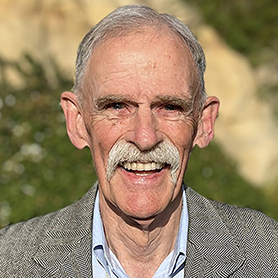
Nick Spitzer
There is a remarkable amount we don’t know about the nervous system. I like to joke that there is huge job security in neuroscience because there are so many questions to answer.
For example, my research has largely been centered around neuronal electrical activity and signaling, and how that activity begins during embryonic development and changes throughout the lifespan. Both in Xenopus (frog) embryos and in embryonic grasshoppers, my lab showed that action potentials initially depend largely on calcium but convert to sodium dependance as development progresses. Other calcium signals regulate axon growth and guidance in embryos of frog and zebrafish. Later, we demonstrated that embryonic and mature neurons can change their signaling molecules (e.g., glutamate to GABA) in response to sustained changes in electrical activity. We’re now investigating how transmitter switching may play a role in PTSD, addiction, and autism. Somehow, after a 50+ year career, I feel as though we’ve uncovered more questions than answers.
“Because of the strong bipartisan support for biomedical research on Capitol Hill, Congress was able to rebuff the administration’s attempt to cut over $24.5 billion from the budgets of NIH and NSF this current fiscal year.”
The vast majority of funding that supports my lab’s discoveries comes from U.S. taxpayers. Without taxpayer support, politicians would not commit tens of billions of dollars each year to biomedical research. Maintaining both public and policymaker support is not easy, but it pays for itself many times over. Because of the strong bipartisan support for biomedical research on Capitol Hill, Congress was able to rebuff the administration’s attempt to cut over $24.5 billion from the budgets of NIH and NSF this current fiscal year.
That is why SfN’s NeuroAdvocates showed up in force during SfN’s Capitol Hill Days in March, as discussion of appropriations for FY 2027 were underway. First and foremost — to thank our champions in Congress for their support. Second, to continue the consistent messaging of why robust research funding is essential for scientific progress.
This year, SfN’s Capitol Hill Days overlapped with Brain Awareness Week (BAW). While our NeuroAdvocates were meeting with policymakers, neuroscientists from around the world were meeting with their local communities. Those of you involved in outreach are building relationships with the public that are just as important as the relationships with politicians on Capitol Hill. Without a public eager for the hope that biomedical research brings, there would be no reason for the public to ask for, and policymakers to provide, the funding research requires.
Capitol Hill Days and BAW also happened the same week SfN’s new executive director, Kevin Marvel, took the helm of the Society. Kevin is only the fourth executive director in SfN’s 57-year history, stepping into the shoes occupied by Marty Saggese for the past 24 years. I am proud to have been chair of the search committee that hired Kevin, who stood out in a field of outstanding candidates. I look forward to supporting Kevin throughout my year as president and to introducing him to many of you at Neuroscience 2026.







