Future of Neuroscience: Lindsay Ejoh
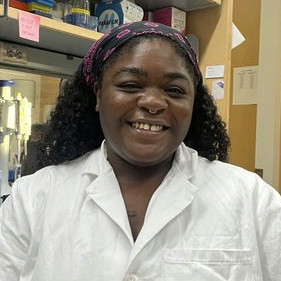
Lindsay Ejoh
“Future of Neuroscience,” a forward-looking complement to SfN’s “History of Neuroscience” autobiographies, is a series of interviews where early career researchers reflect on their career journeys and share thoughts on where neuroscience is headed.
Lindsay Ejoh is a neuroscience PhD candidate at the University of Pennsylvania. Her research in the lab of Gregory Corder investigates thalamic circuits underlying pain and pain relief in mice. Ejoh’s long-term goal is to start her own lab studying chronic pain, with an emphasis on gastrointestinal and other visceral pain disorders.
Outside of the lab, Ejoh uses her popular social media platform (@neuro_melody) to share neuroscience knowledge and her career journey with the general public. Ejoh has partnered with organizations like Museum of Science Boston, LinkedIn, Thermo Fisher Scientific, and Millipore Sigma to translate complex concepts to lay audiences. Ejoh has received recognition from organizations like the National Academy of Sciences, Schmidt Sciences, and Nature for her work using compassionate neuroscience education to combat misinformation and mistrust.
Neuroscience Quarterly (NQ): Why did you decide to pursue neuroscience as a career?
Lindsay Ejoh (LE): From a young age, I thought every STEM class was super cool. They were the hardest classes, but also the most fun. I was curious about everything and spent a lot of free time on educational websites learning about black holes and other amazing science.
I went to a public high school in Maryland that offered a magnet program called the Science and Technology Program. It connected me to a volunteer position at the National Institute of Mental Health where I studied aggression in the medial amygdala in Zheng Li’s lab. As a high schooler, it was extremely gratifying to have the opportunity to code animal behavior videos. I felt like I was contributing to our understanding of the biology of the brain, and it fueled me to major in neuroscience in college.
NQ: What is your current area of research?
LE: Chronic pain is associated with a high prevalence of depression and anxiety, and my research explores ways to treat this negative affect, or the “suffering” component of pain. Opioid drugs like morphine act by uncoupling pain from suffering, leaving patients able to detect the pain without being bothered by it. My PhD work uses techniques like activity-dependent genetic labeling, protein and mRNA fluorescent staining, and viral circuit tracing to investigate brain circuits that contribute to this affective component of pain, specifically mu-opioid receptor-expressing cells in the medial thalamus.
NQ: Beyond research, you’ve become a visible science communicator. How did that start?
LE: As an undergrad, I’d be in classes and in the back of my mind ask myself, how would I explain this to my mom? I thought that was a fun little thought experiment.
Then, as COVID started ramping up, there were a lot of people looking for answers. Twitter became a place for people to learn about mRNA, virology, and genetics. It made me want to join in.
“I’m constantly thinking, ‘Let me make a video about this’ while sitting in seminars, reading papers, or conducting experiments.”
As my PhD research progressed, I made a “day in the life” of a neuroscientist TikTok video that went viral. People started asking all these questions, so I would make follow-up videos, and it continued expanding.
Now it’s just me leaning into my curiosity, leaning into my creativity. I’m constantly thinking, “Let me make a video about this” while sitting in seminars, reading papers, or conducting experiments. Neuroscience is amazing, and I think everyone should know that.
NQ: What are some of the benefits of sharing your work and career journey on social media?
LE: One of the main benefits is having a supportive community. I have this unmatched resource to troubleshoot any issue I’m having in the lab, to commiserate over challenges, to celebrate. Hearing about other peoples’ journeys also helps unmask the hidden curriculum — all of the less-talked-about but important steps to navigating graduate school. This expanded support system has really enriched and supported my PhD experience.
I’m also grateful to not just get more people interested in science, but to help equip those wanting to pursue this career to uncover the mysteries of the human body. Empowering people to pursue their own curiosities has been really rewarding.
On top of all that, I get real visibility to my work. People with chronic pain reach out to me, tell me their stories, and share how our lab’s work is giving them hope. I hear from people whose conditions are relatively understudied — people with sickle cell, endometriosis, bladder pain, colon pain. Even if the work I’m doing doesn’t make it to the clinic in the next five or 10 years, sharing this progress on social media and hearing from the communities it will one day reach connects me to the larger impact now.
NQ: Can you share some challenges you’ve encountered as a neuroscientist on social media?
LE: I exist in the same niche as people who lie and misinform — and I don’t want to be associated with that. The people who are most popular on the STEM side of social media tend to ignore evidence or distort the truth. As much as I’m against existing in the same space as those who misinform, it’s important to be putting reliable information out there.
And of course, there are people leaving hateful comments on my videos. Dealing with the comment section has become a practice in understanding human behavior. My reaction to those comments is generally, “I feel so bad for you. Are you okay?”
At the end of the day, I’m living my dream life conducting cool research and communicating awesome science.
NQ: What advice would you give to other scientists who want to share their work publicly?
LE: If you don’t know where to start, just think about what has excited you the most this week as you’re reading papers, attending seminars and conferences, or preparing your own research work. If you don’t feel comfortable recording yourself, find your medium — make an infographic, write an article, post on LinkedIn or Facebook. It doesn’t have to be the perfect Nature piece or New York Times article to have an impact.
Most importantly, make it accessible. Explain your work at an eighth-grade reading level or lower. Limit your jargon as much as possible, and keep in mind who you’re leaving out of the conversation when you don’t. Who are you trying to communicate to and who might you be inadvertently excluding?